
Neurology and Brain Health
Carpal Tunnel or Pinched Nerve? EMG Testing in San Antonio
Hand tingling can come from the wrist, elbow, neck, or a broader nerve problem. Learn how EMG and nerve conduction testing helps localize the cause.
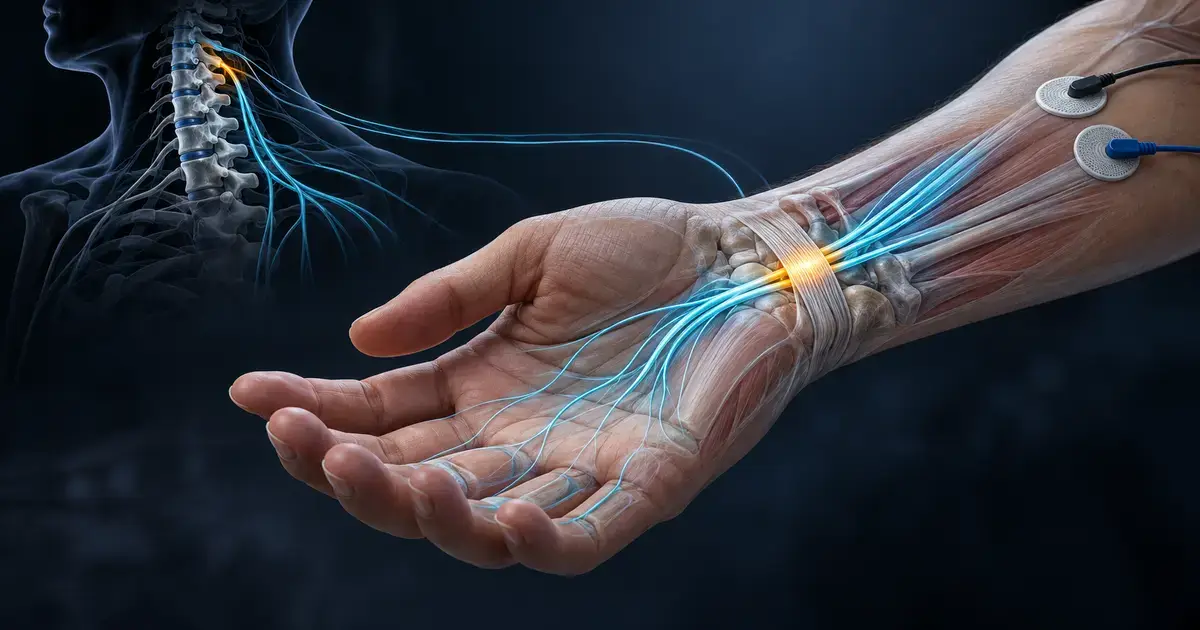
Numbness or tingling in the hand can come from carpal tunnel syndrome, a pinched nerve in the neck, an ulnar nerve problem at the elbow, a broader peripheral neuropathy, or another condition. The pattern of symptoms and neurological examination guide the differential diagnosis. EMG and nerve conduction studies can then help localize a problem and estimate its severity when testing is clinically appropriate.
For patients seeking carpal tunnel EMG testing in San Antonio, the central question is not simply whether the study is “positive.” A useful study asks where nerve function is abnormal, whether more than one site is involved, and whether the findings explain the symptoms.
What carpal tunnel syndrome usually feels like
Carpal tunnel syndrome occurs when the median nerve is compressed as it passes through a narrow space at the wrist. Common symptoms include numbness, tingling, burning, or electric sensations in the thumb, index finger, middle finger, and part of the ring finger. Symptoms often wake people at night or occur while driving, holding a phone, typing, or gripping.
People may shake the hand for temporary relief. As the condition becomes more advanced, grip or pinch strength can decline, objects may be dropped, and muscles at the base of the thumb may shrink. The exact pattern varies, and pain can extend beyond the wrist.
How a pinched neck nerve can mimic carpal tunnel
A cervical radiculopathy occurs when a nerve root in the neck is irritated or compressed. It may cause neck pain radiating into the shoulder or arm, numbness in part of the hand, weakness, or reflex changes. Coughing, straining, or certain neck positions can make symptoms worse.
The sensory territory of a nerve root overlaps with peripheral nerves in the arm, so symptoms do not always follow a perfect textbook map. A patient can also have both carpal tunnel syndrome and a cervical problem. The examination looks for clues in several muscles, reflexes, and sensory areas rather than relying on one painful spot.
Other causes of hand numbness
Ulnar neuropathy often affects the small finger and part of the ring finger and may worsen when the elbow stays bent. Radial nerve problems, brachial plexus injury, generalized peripheral neuropathy, arthritis, tendon disorders, vascular problems, and selected brain or spinal cord conditions can also cause hand symptoms.
Sudden one-sided hand numbness with facial droop, speech difficulty, arm weakness, severe imbalance, or another abrupt neurological symptom can be a stroke warning sign. Call 911 rather than waiting for an EMG appointment.
What nerve conduction studies measure
Small surface electrodes are placed on the skin. Brief electrical pulses stimulate selected nerves while other electrodes record the response. The physician evaluates how quickly and strongly the signal travels across different segments.
In suspected carpal tunnel syndrome, the median nerve response may be compared with nearby nerves in the same hand. These comparisons can reveal focal slowing at the wrist and can help grade severity. Temperature, anatomy, age, prior injury, and technical factors are considered during interpretation.
What needle EMG adds
Needle electromyography uses a thin, sterile, single-use electrode to record electrical activity inside selected muscles. It helps show whether a muscle is receiving normal input from its nerve and nerve root.
The muscle sample is chosen to answer the clinical question. In a patient with hand numbness, the physician may test muscles supplied by different nerves and roots. This can help distinguish a focal wrist problem from a neck-root problem, a more widespread nerve disorder, or selected muscle conditions.
Can EMG tell carpal tunnel from a pinched nerve?
Often it can provide important localization evidence, but no test is perfect. Nerve conduction studies can identify median nerve dysfunction at the wrist. Needle EMG can show changes in muscles that share a cervical root but receive different peripheral nerves, which supports radiculopathy.
A very mild or early problem may not produce a clear abnormality. Intermittent symptoms can occur before measurable nerve injury. Standard studies also do not evaluate every cause of pain or every small sensory fiber. Results must be matched with the history and examination.
When an EMG is most useful
Electrodiagnostic testing may be helpful when:
- The diagnosis is uncertain
- Symptoms involve several nerve territories
- There is objective weakness or muscle loss
- Neck and hand symptoms overlap
- Treatment decisions depend on severity
- Symptoms persist despite splinting or activity changes
- A surgical consultation needs physiological information
- A broader neuropathy is possible
A clinician may not need EMG for every classic, mild case. The decision depends on the diagnostic question, severity, planned treatment, and whether an alternative diagnosis needs to be excluded.
How to prepare for EMG and nerve conduction testing
Keep the skin clean and do not apply lotion or oil to the arms and hands on the day of testing. Wear loose clothing that allows access to the neck, shoulder, arm, and hand. Eat normally and continue medicines unless the practice gives different instructions.
Tell the testing physician about blood thinners, a bleeding disorder, a pacemaker, an implanted defibrillator, a deep-brain stimulator, or another implanted electrical device. Do not stop prescribed medication on your own. Brainology's detailed EMG preparation guide explains both parts of the study and what the sensations may feel like.
What do the results change?
For carpal tunnel syndrome, results may support nonoperative care, a hand-surgery discussion, or closer follow-up depending on severity and clinical findings. For cervical radiculopathy, the study may help identify the involved root and whether there is active or chronic nerve injury. Imaging decisions still depend on the broader clinical picture.
A normal study can also be useful. It may redirect attention toward musculoskeletal pain, very mild intermittent compression, small-fiber symptoms, a central nervous system cause, or another explanation. Normal does not mean imaginary.
What treatment may follow?
Initial carpal tunnel treatment can include a neutral-position wrist splint at night, activity modification, or other clinician-guided options. Persistent weakness, muscle loss, severe electrodiagnostic abnormalities, or progressive symptoms may warrant timely surgical evaluation.
Management of cervical radiculopathy depends on strength, pain, imaging, function, and red flags. Physical therapy, medication, injections, or surgery may be considered in selected cases. New bowel or bladder dysfunction, severe walking difficulty, rapidly worsening weakness, or numbness in the groin area requires urgent evaluation for possible spinal cord or cauda equina compression.
Carpal tunnel and EMG testing in San Antonio
Brainology provides neurology evaluation in San Antonio for hand numbness, weakness, and nerve symptoms. The electrodiagnostic plan is tailored to the symptom pattern rather than using an identical set of nerves and muscles for every patient.
Patients from Shavano Park, Stone Oak, Boerne, the Medical Center, and surrounding communities can bring prior neck imaging, laboratory results, and treatment records to help focus the visit.
Request a Brainology consultation if persistent hand numbness, nighttime tingling, weakness, or neck-to-arm symptoms need a focused neurological assessment.
This article is educational and does not replace diagnosis, emergency care, or individualized medical advice. Testing and treatment should be selected for the patient's history and examination.
References
- National Library of Medicine. Electromyography and Nerve Conduction Studies.
- National Institute of Neurological Disorders and Stroke. Carpal Tunnel Syndrome.
- American Association of Neuromuscular & Electrodiagnostic Medicine. Patient Information: Electrodiagnostic Testing.