Corporate Wellness
Workplace Loneliness Is Not Just Personal: What Employers Can Change
Employees can feel lonely in a crowded office or connected while working remotely. The difference often lies in whether work provides trust, belonging, support, and meaningful relationships rather than simply more interaction.
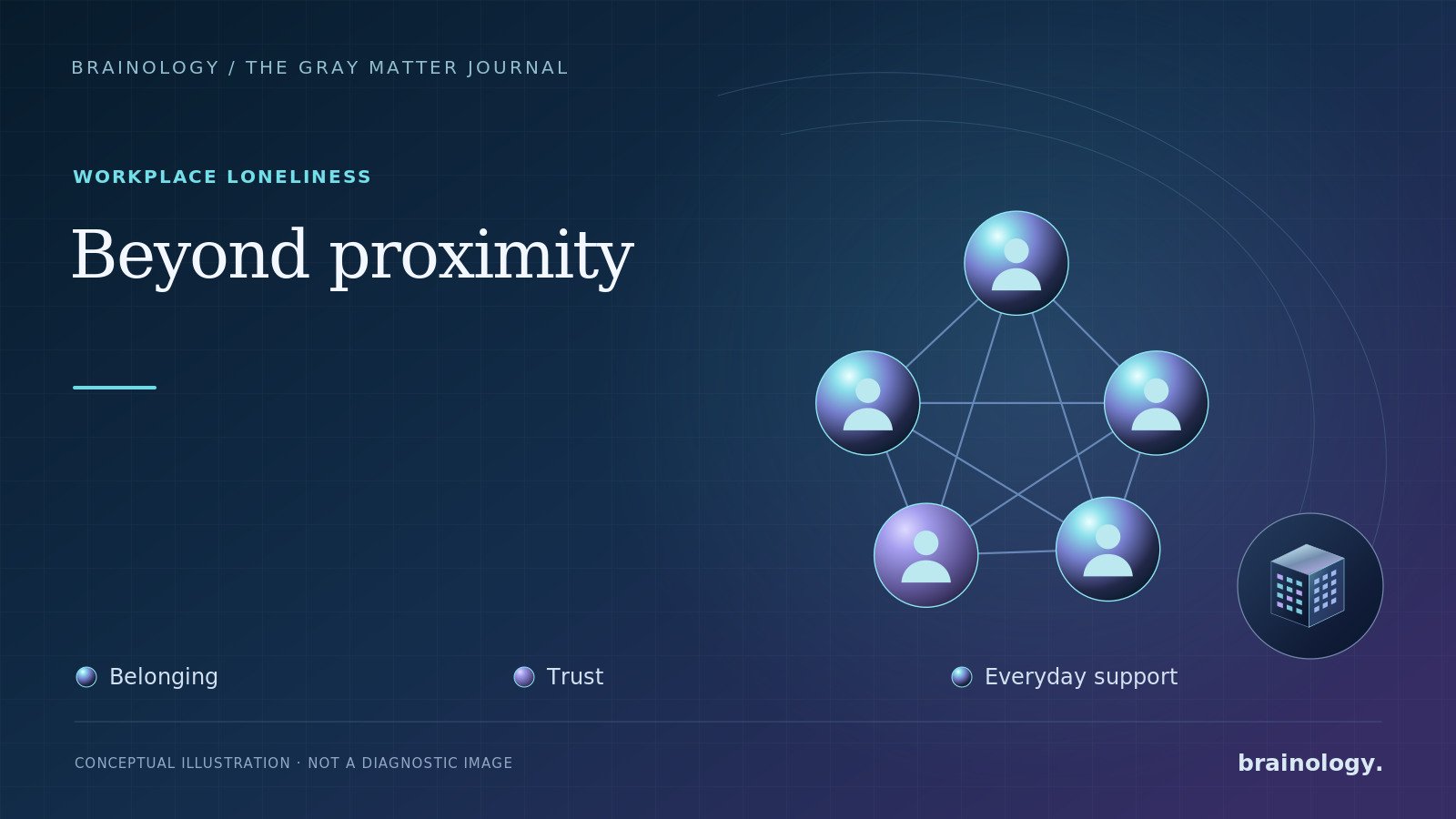
An employee can attend meetings all day, answer dozens of messages, and still feel profoundly alone at work. Loneliness is not the same as physical isolation. It is the distressing gap between the connection someone has and the connection they feel they need.
That distinction matters for corporate wellness. If loneliness is treated only as an individual problem, the standard response becomes a social event, a resilience webinar, or advice to “reach out more.” This can miss conditions that make genuine connection difficult: low trust, poor supervision, exclusion, unstable teams, excessive workload, or work that leaves no room for human interaction.
Employers cannot create friendship on demand. They can, however, shape whether the workplace makes respect, support, and belonging more or less likely.
Workplace Loneliness Is More Than Working Alone
Social isolation is an objective lack of contact or relationships. Loneliness is subjective. A remote employee with strong relationships and reliable team support may not feel lonely. An on-site employee surrounded by coworkers may feel disconnected if interactions are superficial, competitive, dismissive, or unsafe.
Workplace loneliness specifically concerns the relationships and sense of connection experienced within work. It can affect new hires, executives, frontline workers, caregivers, people who work remotely, and employees who feel different from the dominant culture. It should not be assumed from job title, location, age, or personality.
A 2026 systematic review and meta-analysis estimated that about 14% of workers met a moderate threshold for workplace loneliness. That figure should be interpreted cautiously. Only three studies qualified, all were cross-sectional, the results varied substantially, and the studies came from Europe and Asia. The estimate is useful as a signal that the issue is not rare, but it is not a precise prevalence rate for every organization or workforce.
What the Evidence Shows, and What It Does Not
The World Health Organization’s June 30, 2025 report on social connection concluded that loneliness and social isolation are important global health concerns associated with mental and physical health outcomes and premature mortality. Much of that evidence concerns loneliness across life, not loneliness limited to the workplace.
Workplace-specific research is newer. A mixed-method systematic review found associations between workplace loneliness and lower job satisfaction, poorer work performance, weaker worker-manager relationships, and greater burnout. The authors emphasized that most included studies were cross-sectional and often did not adequately address confounding.
In plain language, lonely employees tend to report worse occupational well-being, but these studies cannot prove that loneliness caused every outcome. The relationship may operate in both directions. A hostile work environment may contribute to loneliness; depression, illness, or stress outside work may also change how workplace relationships are experienced. Often, several factors interact.
Why Mandatory Fun Is Not a Connection Strategy
A packed social calendar can create contact without creating belonging. Mandatory celebrations, forced icebreakers, and highly personal sharing exercises may feel energizing to some employees and uncomfortable to others. They may also disadvantage caregivers, remote workers, people with disabilities, employees with different cultural expectations, or anyone who needs clearer boundaries between work and private life.
Other incomplete responses include:
- Requiring office attendance without improving team culture
- Telling employees to be more outgoing
- Treating an employee assistance program as the entire solution
- Using digital surveillance to infer who is socially engaged
- Expecting employee resource groups to repair broader management failures
- Adding social events to an already overloaded schedule
Connection is more likely to grow when people can rely on one another, contribute meaningfully, ask for help, and be recognized as individuals. It is the quality of interaction, not simply its volume, that matters.
Start With the Design of Everyday Work
The most sustainable opportunities for connection are often built into the work itself.
Create stable points of contact. New hires and employees changing roles benefit from a clearly identified manager, onboarding partner, or peer mentor. Scheduled early check-ins can prevent weeks of uncertainty about where to ask basic questions.
Make collaboration real. Shared problem-solving, peer consultation, and small project teams can create purposeful interaction. Connection is less likely when every task is individualized and coworkers meet only to exchange status updates.
Protect time for relationships. If workloads leave no room for teaching, listening, or informal conversation, leaders should not be surprised when connection erodes. Adding a social initiative without addressing capacity can become another burden.
Build inclusive meetings. Rotate who speaks first, distribute agendas in advance, invite input through more than one channel, and document decisions. These practices help employees participate without requiring the most extroverted communication style.
Recognize contribution specifically. Generic praise can feel performative. Naming how someone’s work helped a colleague, patient, customer, or team reinforces both meaning and interdependence.
Preserve appropriate flexibility. Remote and hybrid work are not automatically isolating, just as office work is not automatically connecting. Teams need predictable communication norms, equitable access to information, and intentional opportunities for participation across locations.
Managers Can Help Without Becoming Therapists
Supervisors strongly influence whether employees experience support and belonging. They do not need to diagnose loneliness or provide mental health treatment. Their role is to notice changes, make it safe to raise concerns, connect employees with resources, and address work conditions within their control.
Useful questions include:
- “Do you have the people and information you need to do your work?”
- “Where are you feeling left out of decisions or communication?”
- “Who can you turn to when you are stuck?”
- “What would help you feel more connected to this team?”
There is emerging experimental evidence that manager behavior can make a difference. In a 2024 cluster-randomized trial, 99 active-duty U.S. Army platoon leaders received a 90-minute supportive-leadership training. Service members under trained leaders reported reduced loneliness compared with controls, with some effects assessed three months later.
That is encouraging, but it is one trial in a specific high-risk occupational setting. It does not prove that a brief training will work equally well in hospitals, technology firms, small businesses, or fully remote teams. Organizations should adapt interventions to context and evaluate whether they help.
Measure Without Stigmatizing
An organization can include a small number of validated connection or belonging questions in a confidential workforce assessment. Results should be examined at the team or organizational level when sample size protects anonymity. Employees should know why the information is being collected, who can see it, and how it will be used.
Do not ask managers to label individual employees as lonely. Do not treat meeting attendance, chat activity, or office presence as a proxy for belonging. These measures can be misleading and may damage trust.
Useful organizational indicators may include onboarding experience, perceived supervisor support, psychological safety, inclusion in decisions, access to peer help, turnover intention, and whether employees feel respected. The purpose is to identify patterns that leadership can change, not to rank employees by sociability.
Connection Does Not Replace Mental Health Care
Workplace changes can reduce unnecessary barriers to connection, but they are not treatment for depression, anxiety, trauma, or another health condition. Employees should have confidential access to appropriate care without being required to disclose a diagnosis to their manager.
Persistent loneliness accompanied by hopelessness, loss of interest, severe anxiety, substance misuse, or thoughts of self-harm deserves prompt professional attention. In the United States, anyone in emotional crisis can call or text 988 for immediate support.
A Better Corporate Wellness Goal
The goal is not to make every coworker a close friend. It is to create a workplace where people are known, respected, included, and able to seek help without penalty. Leaders can begin by asking whether daily work practices support those conditions.
A practical starting plan is to strengthen onboarding, train managers in supportive behaviors, create meaningful peer connections, make meetings more inclusive, and reassess results. Small relational practices can matter, but they work best when supported by reasonable workloads, fair policies, and trustworthy leadership.
Brainology can help organizations develop clinically responsible wellness education and workplace strategies that support mental, neurologic, and sleep health without reducing complex concerns to a one-size-fits-all program.
This draft is for educational purposes and does not provide medical, psychiatric, legal, or human-resources advice. Workplace programs should protect confidentiality and complement access to qualified care.
References
- World Health Organization. From loneliness to social connection: Charting a path to healthier societies. June 30, 2025.
- Office of the U.S. Surgeon General. Our Epidemic of Loneliness and Isolation: The U.S. Surgeon General’s Advisory on the Healing Effects of Social Connection and Community. 2023.
- Bryan BT, Andrews G, Thompson KN, Qualter P, Matthews T, Arseneault L. Loneliness in the workplace: A mixed-method systematic review and meta-analysis. Occupational Medicine. 2023;73(9):557-567.
- Hajek A, König HH. Prevalence of workplace loneliness: A systematic review and meta-analysis. Journal of Public Health. Published July 28, 2026.
- Mohr CD, Hammer LB, Dimoff JK, et al. Supportive-leadership training to improve social connection: A cluster-randomized trial demonstrating efficacy in a high-risk occupational context. Journal of Occupational Health Psychology. 2024;29(5):299-316.
- Sasaki N, Tsuno K, Kuroda R, et al. Workplace loneliness and job turnover: A 6-month prospective study. Journal of Occupational Health. 2025;67(1):uiaf009.