Corporate Wellness
Returning to Work After a Concussion: An Employer’s Practical Guide
Returning to work after a concussion is not the same as returning to full duty. A flexible, clinician-guided plan can help employees resume useful work while managing symptoms and avoiding tasks that create a risk of another injury.
A concussion can be easy to underestimate. The employee may look well but still have headaches, dizziness, fatigue, slowed thinking, light or noise sensitivity, sleep changes, or difficulty concentrating. Symptoms can also change during recovery.
For employers, the goal is not to decide whether the employee is “really” injured. It is to create a safe bridge between medical restrictions and the actual demands of the job. Returning to work is not the same as returning immediately to full hours, full productivity, driving, heights, heavy equipment, or other safety-sensitive duties.
The Centers for Disease Control and Prevention (CDC) notes that some people return within days with short-term support, while others need weeks, months, or longer. The timeline depends on the injury, symptoms, job tasks, and individual recovery.[1] A useful return-to-work plan is therefore specific, temporary, and reviewed regularly.
Start With Medical Care, Not Workplace Guesswork
Concussion is a medical diagnosis. An employer should not diagnose it, determine when driving is safe, or tell an employee to “push through” symptoms. After a head injury, the employee should receive appropriate clinical evaluation and written guidance about restrictions, abilities, and follow-up.
Emergency warning signs require urgent care. CDC advises immediate emergency evaluation for danger signs such as a worsening headache that does not go away, repeated vomiting, seizures, slurred speech, weakness or numbness, unusual behavior, one pupil larger than the other, or increasing confusion, agitation, drowsiness, or inability to wake.[2] A workplace plan does not replace emergency procedures.
Privacy still matters. Managers generally need to know what the employee can and cannot safely do, not every detail of the diagnosis or medical record. Human resources, occupational health, and legal teams should align the process with applicable disability, leave, workers’ compensation, privacy, and safety requirements.
Brief Rest Is Different From Prolonged Isolation
Older concussion advice often emphasized complete rest until all symptoms disappeared. Current guidance has shifted. CDC recommends easing back into regular activities after one or two days of rest, even if mild symptoms remain, while avoiding activities that risk another head injury.[3] The Living Concussion Guidelines similarly recommend a gradual return after a brief 24- to 48-hour period of relative rest, based on tolerance and clinical guidance.[4]
This does not mean everyone should return on day three. It means prolonged inactivity is not automatically the safest or fastest route. An employee may be able to perform some useful tasks before being ready for unrestricted duty. Safety-sensitive work may require a longer absence or tighter restrictions than desk-based work.
Build the Plan Around Job Demands
A generic note that says “light duty” is often too vague. Break the job into demands that a clinician and employee can evaluate:
- Cognitive: sustained attention, rapid decisions, multitasking, complex calculations, high call volume, or time pressure.
- Sensory: bright light, loud noise, multiple screens, flashing displays, or visually busy environments.
- Physical: lifting, climbing, rapid movement, heat exposure, or prolonged standing.
- Safety-critical: driving, operating machinery, working at heights, handling hazardous materials, carrying a weapon, or protecting the public.
- Schedule-related: long shifts, night work, overtime, unpredictable hours, or limited break coverage.
CDC identifies driving, heavy equipment, heights, intense physical activity, concentration-heavy tasks, and high-stress or high-risk work as factors that may require more time away or added restrictions.[1] The point is not to label a job as “safe” or “unsafe” in the abstract. It is to identify the specific duties that are compatible with the employee’s current abilities.
Use Temporary, Symptom-Linked Accommodations
Accommodations should target a functional problem and be adjusted as recovery changes. Examples include:
- Shorter shifts or a later start time
- Scheduled rest breaks in a quiet area
- Reduced screen time, lower visual complexity, or assistive software
- Earplugs, headphones, or modified lighting when clinically appropriate
- Fewer simultaneous assignments and extended time for tasks
- Written instructions, checklists, and reduced interruption
- Temporary reassignment away from driving, machinery, heights, heavy exertion, or other re-injury risks
- Remote or hybrid work when it actually reduces triggers and still fits the role
These are options, not a universal checklist. Sunglasses indoors, for example, may help one employee but be unnecessary or counterproductive for another. Remote work may reduce commuting but increase screen exposure. The employee, clinician, and employer should choose accommodations that match symptoms and job demands.[1,5]
CDC offers a return-to-work instruction form that clinicians can use to specify changes such as reduced screen time, quiet breaks, shortened hours, and temporary limits on driving or equipment use.[5]
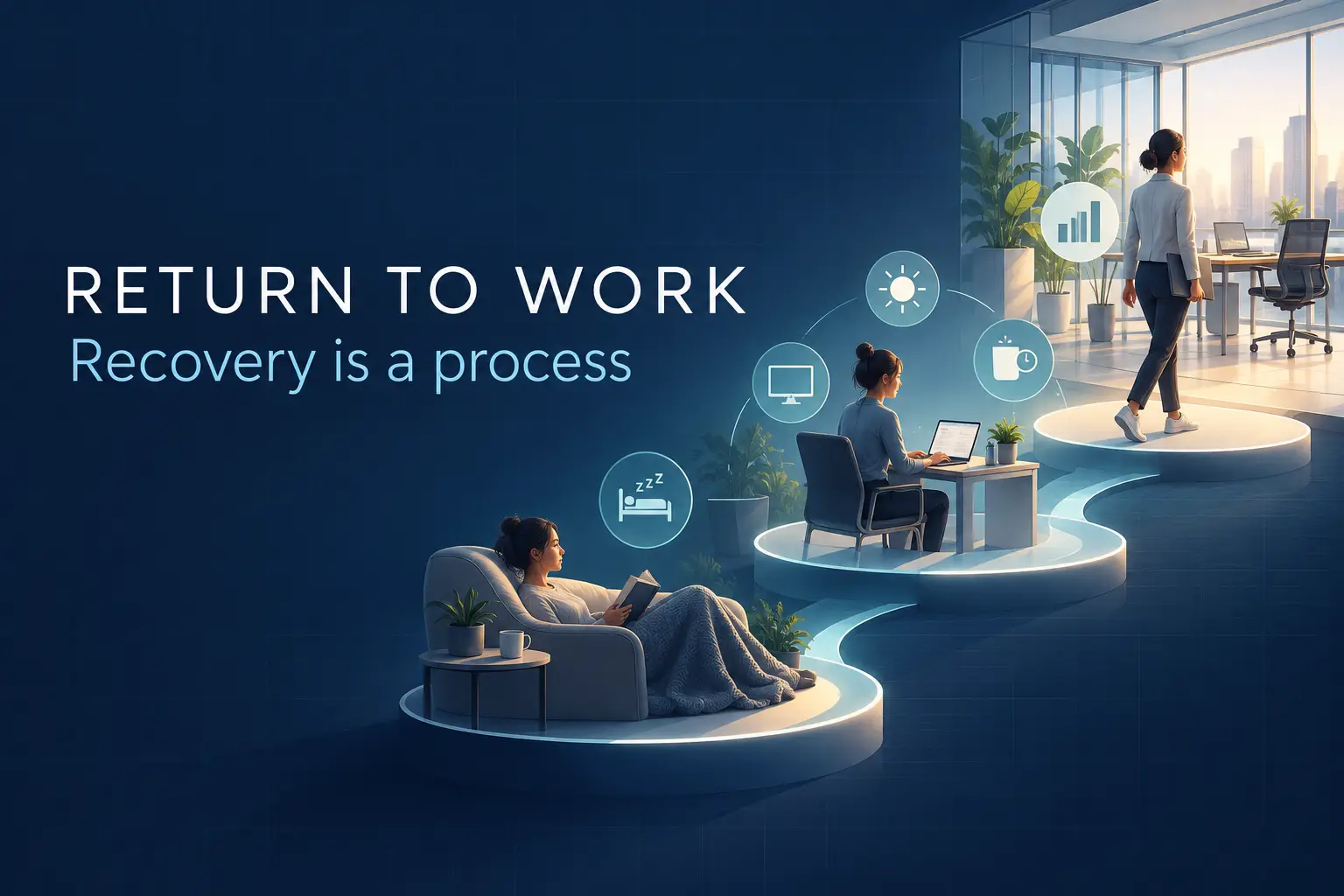
Make the Return Gradual and Reversible
A staged plan might begin with fewer hours and lower-complexity tasks, then increase one demand at a time. Avoid changing hours, workload, sensory exposure, and safety responsibilities all at once. If symptoms rise and stay elevated, the plan may need to pause or step back while the employee contacts the treating clinician.
A brief increase in symptoms during activity does not necessarily mean new brain damage, but employers should not set their own symptom thresholds or pressure employees to tolerate substantial worsening. Any new injury, new neurologic symptom, or emergency warning sign requires prompt medical reassessment.
Set a review date rather than an arbitrary recovery deadline. Useful questions include:
- Which duties were completed safely?
- Which tasks triggered symptoms?
- Were breaks available when needed?
- Did symptoms settle after the shift?
- Has the clinician changed any restrictions?
- Is the next step an increase, no change, or a temporary reduction?
Coordinate Without Making the Employee the Messenger
Recovery is harder when the employee must repeatedly explain the condition to a manager, scheduler, human resources, insurer, and every coworker. With appropriate consent, designate one coordinator for restrictions and plan updates. Give the supervisor only the information needed to implement the arrangement.
Coworkers may need to know that duties are temporarily reassigned, but not why. A neutral message such as “This is a time-limited medical accommodation” can protect privacy and reduce speculation.
Consistency matters. A supportive written plan can prevent well-meaning supervisors from adding overtime, urgent deadlines, or driving duties before those activities are cleared.
Know When Recovery Needs More Support
Most people improve over days to weeks, but some experience persistent symptoms.[2,3] When progress stalls, the answer is not automatically more rest or more effort. Headache, sleep disturbance, mood symptoms, neck injury, balance problems, vision symptoms, and other conditions may require targeted evaluation.
A 2025 systematic review found that interventions such as early education, psychological care, exercise, vestibular or vision rehabilitation, cognitive strategies, vocational support, and interdisciplinary care may help adults return to work. However, the studies varied in design, patient population, and outcome measures, so the review does not establish one best program for every worker.[6]
Employers can support access to qualified care through occupational health, health benefits, employee assistance programs, or case management. They should not prescribe rehabilitation or make employment decisions from a symptom score alone.
Measure Whether the Plan Works
Track function and safety, not just the date an employee first clocks in. Useful measures include sustained hours, successful completion of modified duties, symptom-triggered plan changes, near misses, re-injury, and whether accommodations were delivered as written.
Return-to-work research is still developing. Evidence supports individualized, gradual activity and temporary accommodations, but it does not justify a guaranteed recovery timeline or a claim that one workplace protocol will prevent persistent symptoms.[4,6] The best plan is a living document that follows clinical guidance and changes as the employee recovers.
Frequently Asked Questions for Employers
How soon can an employee return to work after a concussion?
There is no universal deadline. Some employees can resume limited duties within days, while others need a longer recovery. The plan should reflect symptoms, medical guidance, job demands, and re-injury risk.
What workplace accommodations may help after a concussion?
Common temporary options include shorter shifts, quiet breaks, reduced screen exposure, fewer simultaneous tasks, written instructions, modified lighting, and removal from driving, machinery, heights, or other safety-sensitive duties when clinically indicated.
Does an employer need the employee’s full medical record?
Usually the operational need is to understand functional restrictions, expected duration, and review dates. Employers should coordinate with human resources, occupational health, and legal counsel regarding applicable privacy and disability requirements.
A Practical Brainology Role
Brainology’s corporate-wellness program can help organizations provide evidence-based concussion education, identify appropriate clinical referral pathways, and design manager training that supports safe, privacy-conscious return-to-work conversations. Workplace policies should be reviewed with occupational health, safety, human resources, legal, and employee representatives before implementation.
This article is for general educational purposes. It is not medical advice, legal advice, or a substitute for emergency care, a clinician’s recommendations, or job-specific safety requirements.
References
- Centers for Disease Control and Prevention. TBI in the Workplace Facts. Updated 2025. Accessed October 8, 2026.
- Centers for Disease Control and Prevention. Symptoms of Mild TBI and Concussion. Updated September 15, 2025. Accessed October 8, 2026.
- Centers for Disease Control and Prevention. What to Do After a Mild TBI or Concussion. Accessed October 8, 2026.
- Living Concussion Guidelines. Return-to-Activity / Work / School Considerations. Ontario Ministry of Health. Accessed October 8, 2026.
- Centers for Disease Control and Prevention. Instructions on Returning to Work. Accessed October 8, 2026.
- Ethier-Gagnon M, Lithopoulos A, Pattison M, et al. Interventions to help adults with concussion return to work: A systematic review. PM R. 2025;17(7):830-849. doi:10.1002/pmrj.13359.