Neurology and Brain Health
Drooping Eyelids, Double Vision, and Muscle Fatigue: Could It Be Myasthenia Gravis?
Myasthenia gravis can cause eyelid drooping, double vision, slurred speech, trouble swallowing, or limb weakness that changes through the day. Here is how to recognize the pattern, when to seek emergency care, and what a neurological evaluation may include.
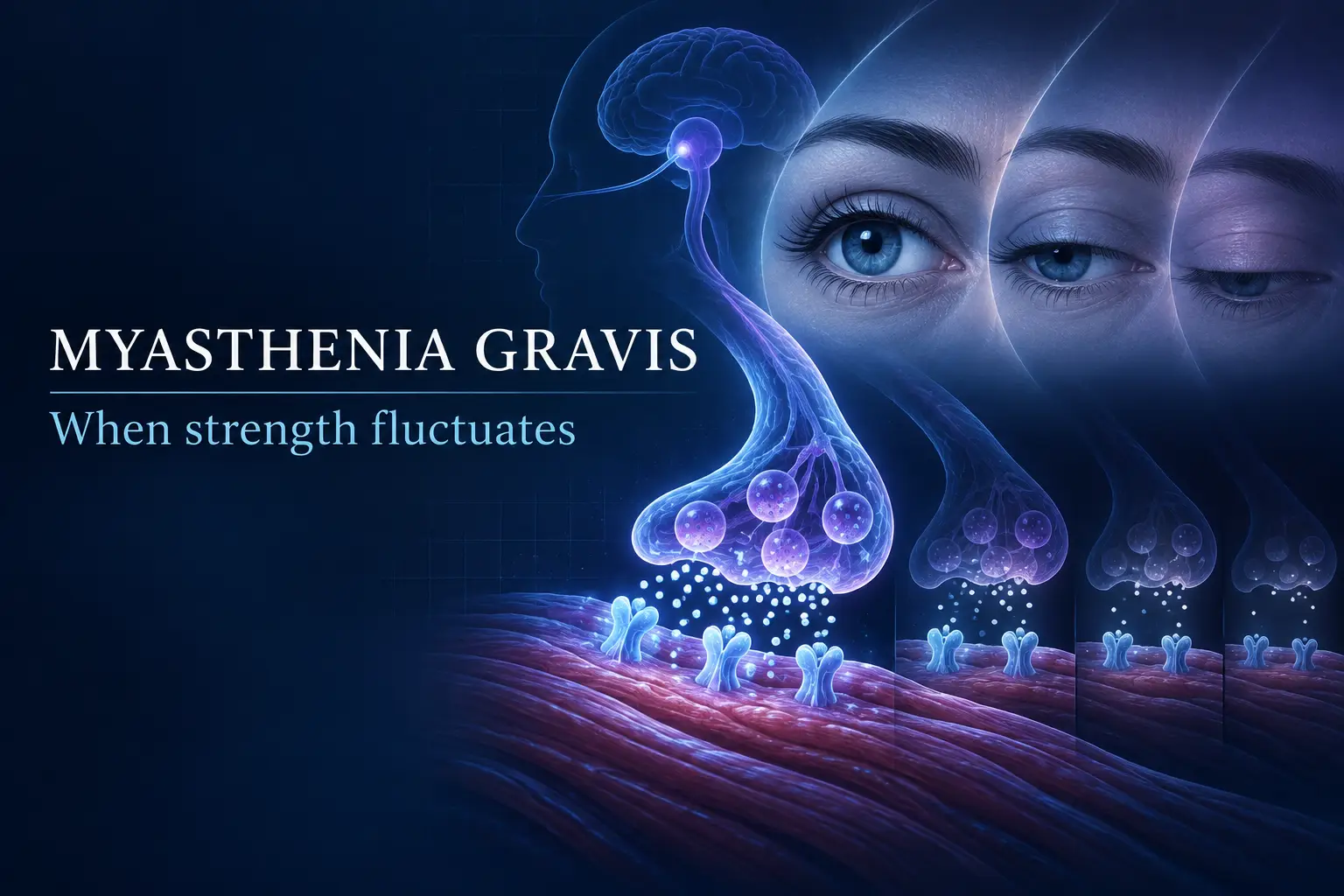
A drooping eyelid at the end of the day. Double vision that improves after closing the eyes. A voice that becomes softer while talking. Arms that feel strong at first but weaken with repeated activity.
These symptoms can have many causes. One possibility is myasthenia gravis, an autoimmune neurological condition that disrupts communication between nerves and voluntary muscles. Its hallmark is not ordinary tiredness. It is fluctuating, fatigable muscle weakness: a specific muscle group becomes weaker with use and may recover, at least partly, after rest.
Myasthenia gravis is treatable, but it can be difficult to recognize because symptoms may come and go. A careful history, neurological examination, and targeted testing matter. No single symptom or home test can establish the diagnosis.
What Happens at the Neuromuscular Junction?
Every voluntary movement depends on a signal passing from a nerve to a muscle at a microscopic connection called the neuromuscular junction. The nerve releases acetylcholine, a chemical messenger that binds to receptors on the muscle and helps trigger contraction.
In autoimmune myasthenia gravis, antibodies interfere with proteins needed for this signaling. The most commonly identified antibodies target the acetylcholine receptor (AChR). Others may target muscle-specific kinase (MuSK) or, less commonly, other proteins involved in the same system. When the signal's safety margin is reduced, repeated activity can expose the problem and weakness becomes more noticeable.
This mechanism helps explain why myasthenia gravis causes weakness rather than numbness. Sensation is usually preserved. It also differs from generalized fatigue, sleepiness, or low stamina, although those experiences can coexist.
Symptoms That Can Point Toward Myasthenia Gravis
The pattern varies from person to person. Symptoms can remain limited to the eye muscles, called ocular myasthenia, or involve muscles elsewhere in the body, called generalized myasthenia.
Common symptoms include:
- Drooping of one or both eyelids, known as ptosis
- Double vision caused by weakness of the eye-movement muscles
- A smile that looks uneven or becomes difficult to sustain
- Speech that becomes slurred, nasal, quiet, or less clear with continued talking
- Trouble chewing, especially later in a meal
- Coughing, choking, or difficulty swallowing
- Difficulty holding up the head
- Arm or leg weakness, such as trouble washing hair, climbing stairs, or rising from a chair
- Shortness of breath caused by respiratory muscle weakness
Weakness often worsens with repeated use, later in the day, during illness, or after physical stress, and may improve with rest. However, that pattern is not universal. Symptoms may fluctuate over hours, days, or longer periods.
These features are clues, not proof. Thyroid eye disease, cranial nerve disorders, stroke, medication effects, other neuromuscular-junction disorders, motor neuron disease, and several muscle conditions can sometimes look similar. Sudden facial droop, new one-sided weakness, severe imbalance, or difficulty speaking should be treated as a possible stroke and evaluated immediately.
When Weakness Becomes an Emergency
A myasthenic crisis occurs when respiratory weakness becomes severe enough to threaten breathing. It is a medical emergency and may require intensive monitoring and ventilatory support.
Call 911 or seek emergency care for shortness of breath, rapidly worsening trouble swallowing, repeated choking, difficulty managing saliva or secretions, a weak cough, or an inability to speak comfortably because of breathlessness. Do not drive yourself if breathing or swallowing is impaired.
Infection, surgery, medication changes, and other physical stresses can worsen myasthenia gravis, but a trigger is not always obvious. If you already have the diagnosis, keep an updated medication list and emergency information accessible to family and clinicians.
How Neurologists Test for Myasthenia Gravis
The diagnosis begins with the clinical pattern. A neurologist may look for eyelid drooping, changing eye alignment, weakness after repeated movements, speech changes, neck weakness, and problems with chewing or swallowing. Testing is then selected to support the diagnosis and identify the disease subtype.
Antibody blood tests
Blood testing commonly starts with AChR antibodies. Depending on the findings and clinical picture, testing may include MuSK antibodies and, in selected cases, LRP4 or specialized cell-based assays. A positive disease-specific antibody can strongly support the diagnosis.
A negative antibody result does not automatically rule out myasthenia gravis, particularly when symptoms are limited to the eyes. Some people have clinically convincing disease without antibodies detected on standard testing. This is one reason results must be interpreted alongside the examination and other tests.
Electrodiagnostic testing
Repetitive nerve stimulation evaluates how muscle responses change when a nerve is stimulated several times. Single-fiber electromyography, or single-fiber EMG, measures small variations in neuromuscular transmission and can be especially sensitive. However, an abnormal single-fiber EMG is not unique to myasthenia gravis. Test technique, the muscles studied, medications, and the overall clinical context all affect interpretation.
Imaging and additional evaluation
Once autoimmune myasthenia gravis is diagnosed, chest CT or MRI is generally used to evaluate the thymus gland and look for a thymoma. Other blood tests or imaging may be appropriate when clinicians are considering thyroid disease, structural brain or nerve problems, or another cause of weakness.
Treatment Is Individualized
Treatment depends on which muscles are affected, symptom severity, antibody status, age, other health conditions, and personal goals. Options may include:
- Pyridostigmine, which can temporarily improve signaling between nerves and muscles
- Corticosteroids or other immune therapies to reduce the autoimmune attack
- Targeted biologic treatments for selected people with generalized disease
- Intravenous immunoglobulin (IVIG) or plasma exchange when faster improvement is needed, including some severe exacerbations
- Thymectomy when a thymoma is present and for selected people without thymoma
The randomized MGTX trial found that thymectomy plus prednisone improved outcomes and reduced prednisone requirements compared with prednisone alone in a defined group of adults with generalized, AChR-antibody-positive, nonthymomatous myasthenia gravis. That result does not mean thymectomy is right for everyone. Eligibility and expected benefit depend on disease subtype, age, surgical risk, and other factors.
Newer treatments have expanded the options for generalized myasthenia gravis, but long-term comparative evidence remains incomplete. A neuromuscular specialist can help balance likely benefit, infection risk, monitoring needs, pregnancy plans, cost, and treatment burden.
Medication Safety: Caution Does Not Always Mean “Never”
Some medications have been associated with worsening myasthenic weakness. The Myasthenia Gravis Foundation of America lists fluoroquinolone, macrolide, and aminoglycoside antibiotics; intravenous magnesium; beta-blockers; botulinum toxin; and several other drugs as agents that may require avoidance or caution. Fluoroquinolone antibiotics carry an FDA boxed warning regarding worsening myasthenia gravis.
An association does not prove that every listed drug will cause a flare in every patient. Some reports are rare, and a medication may still be medically necessary. Do not stop a prescription suddenly or reject needed treatment on your own. Tell every prescriber, dentist, pharmacist, and surgical team about the diagnosis, and contact the treating clinician promptly if weakness changes after a new medication.
A Symptom Diary Can Make the Visit More Useful
Because symptoms fluctuate, a brief record can help. Note which muscle group becomes weak, what activity brings it on, how long recovery takes, and whether chewing, swallowing, speaking, or breathing is affected. With consent and attention to privacy, a short photo or video of intermittent eyelid drooping or speech change may also help a clinician understand what happens outside the exam room.
Frequently Asked Questions About Myasthenia Gravis
What are the first signs of myasthenia gravis?
Early symptoms often include fluctuating eyelid drooping, double vision, speech or chewing difficulty, or muscle weakness that becomes more noticeable with repeated activity. These symptoms have other possible causes, so neurological evaluation is important.
Can myasthenia gravis cause numbness?
Myasthenia gravis primarily affects muscle activation rather than sensation. Prominent numbness, tingling, or pain may point toward another or additional neurological problem.
What test confirms myasthenia gravis?
No single test is perfect for every patient. Diagnosis may combine the clinical pattern with antibody testing, repetitive nerve stimulation, single-fiber EMG, and imaging of the thymus when appropriate.
If fluctuating weakness is affecting vision, speech, swallowing, or movement, Brainology’s neurology team can provide a neurological evaluation and coordinate appropriate antibody, imaging, and electrodiagnostic testing when indicated. The goal is not to force every symptom into one diagnosis, but to identify the pattern accurately and move toward the safest next step.
This article is for education and does not replace individualized medical advice. New or rapidly worsening breathing or swallowing difficulty requires emergency evaluation.
References
- National Institute of Neurological Disorders and Stroke. Myasthenia Gravis. Updated March 13, 2026.
- Narayanaswami P, Sanders DB, Wolfe G, et al. International Consensus Guidance for Management of Myasthenia Gravis: 2020 Update. Neurology. 2021;96(3):114-122. doi:10.1212/WNL.0000000000011124.
- Yoganathan K, Stevenson A, Tahir A, et al. Bedside and laboratory diagnostic testing in myasthenia. Journal of Neurology. 2022;269(6):3372-3384. doi:10.1007/s00415-022-10986-3.
- Wolfe GI, Kaminski HJ, Aban IB, et al. Randomized Trial of Thymectomy in Myasthenia Gravis. New England Journal of Medicine. 2016;375(6):511-522. doi:10.1056/NEJMoa1602489.
- Wolfe GI, Kaminski HJ, Aban IB, et al. Long-term effect of thymectomy plus prednisone versus prednisone alone in patients with non-thymomatous myasthenia gravis: 2-year extension of the MGTX randomised trial. Lancet Neurology. 2019;18(3):259-268. doi:10.1016/S1474-4422(18)30392-2.
- Myasthenia Gravis Foundation of America. MG Emergencies. Accessed October 10, 2026.
- Myasthenia Gravis Foundation of America. Cautionary Drugs. Accessed October 10, 2026.
- Myasthenia Gravis Foundation of America. Myasthenia Gravis Treatments. Accessed October 10, 2026.