Sleep Medicine and Sleep Testing
Is the MSLT a Narcolepsy Test? Why Preparation Can Change the Result
The Multiple Sleep Latency Test measures how quickly someone falls asleep and whether REM sleep appears unusually early. It is useful for evaluating severe daytime sleepiness, but it is not a stand-alone blood test for narcolepsy. Proper preparation is part of the test.
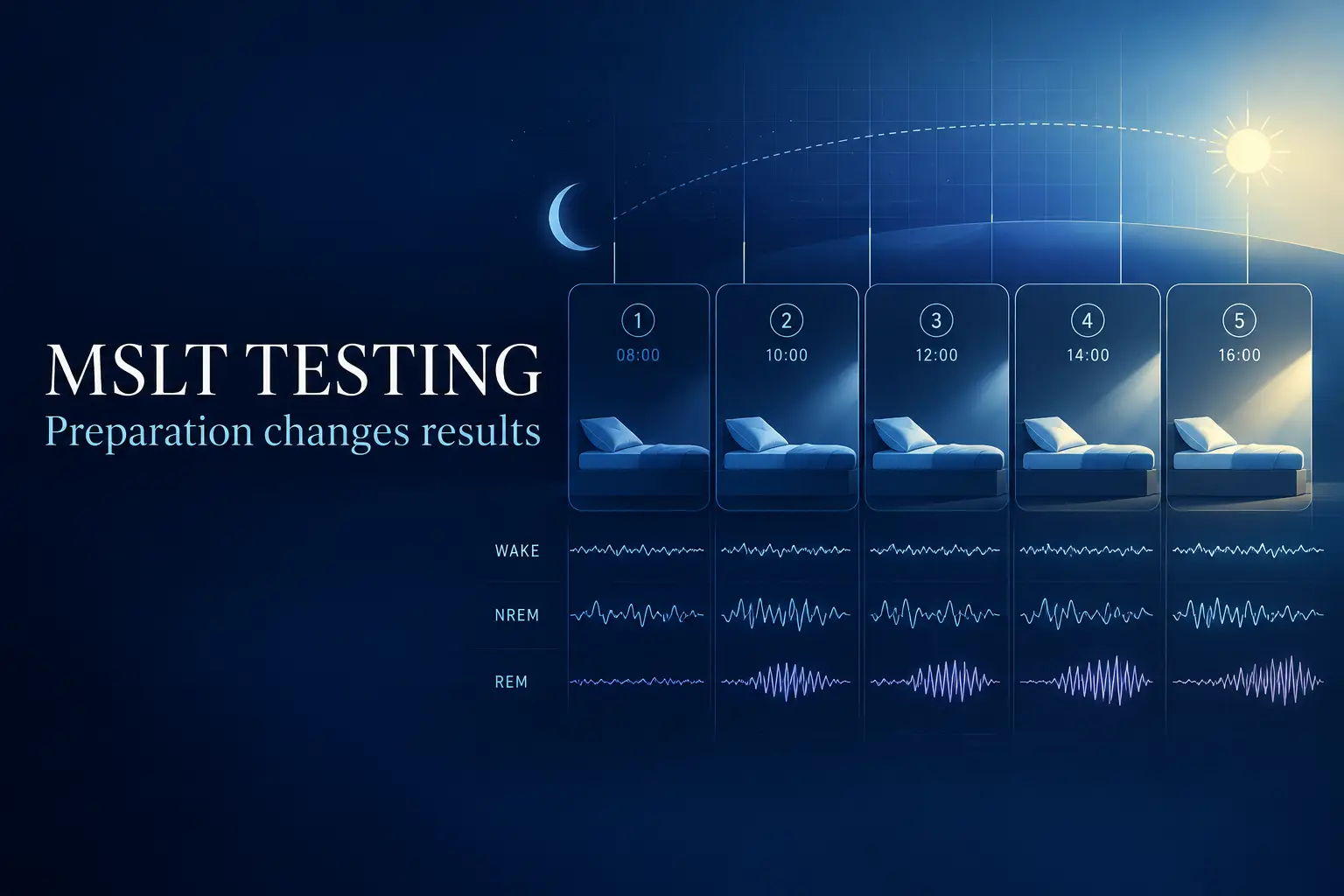
Patients are often told that an MSLT will determine whether they have narcolepsy. That is understandable shorthand, but it is incomplete.
The Multiple Sleep Latency Test, or MSLT, is an objective daytime measurement of sleep tendency. It can provide important evidence for narcolepsy and idiopathic hypersomnia. Its results can also be changed by insufficient sleep, shift work, circadian timing, untreated sleep disorders, medications, and medication withdrawal.
For that reason, a technically “positive” or “negative” MSLT must be interpreted together with the clinical history, the preceding overnight sleep study, sleep-schedule documentation, and the preparation used before testing.
What happens during an MSLT?
An adult MSLT is normally performed in a sleep laboratory on the day after an attended overnight polysomnogram. The overnight study records sleep stages, breathing, oxygen, heart rhythm, leg movements, and other signals. It helps determine whether another condition, such as obstructive sleep apnea or insufficient sleep during the study night, could explain daytime sleepiness or distort the daytime test.
During the MSLT, the patient receives five scheduled nap opportunities, generally separated by two hours. The main measurements are:
- Mean sleep latency: the average time required to fall asleep across the naps
- Sleep-onset REM periods, or SOREMPs: naps in which REM sleep begins unusually soon after sleep onset
A mean sleep latency of 8 minutes or less with at least two SOREMPs can support a narcolepsy diagnosis. In some circumstances, a SOREMP on the preceding overnight study can count toward the total. These measurements do not establish the diagnosis by themselves. Symptoms, duration, alternative explanations, and other diagnostic criteria still matter.
Sleepiness is not the same as fatigue
The MSLT measures the physiologic tendency to fall asleep under quiet, controlled conditions. It does not directly measure exhaustion, low energy, brain fog, weakness, or poor motivation.
A person can feel profoundly fatigued but remain awake during every nap. Another person may underestimate their sleepiness yet fall asleep rapidly. Depression, anemia, thyroid disease, medications, chronic pain, insufficient sleep, and many neurologic or medical disorders can produce overlapping complaints.
This is why the evaluation begins before the electrodes are applied. The clinician must first determine whether the primary problem is sleepiness, fatigue, long sleep duration, disrupted sleep, or a combination.
Why two weeks of sleep information matters
The American Academy of Sleep Medicine recommends documenting adequate sleep with a sleep diary and, when available, actigraphy for two weeks before testing. Actigraphy uses a wrist-worn movement sensor to estimate sleep-wake timing across many days.
This step is not paperwork for its own sake. Chronic sleep restriction can make a person fall asleep rapidly and may contribute to a false-positive result. One normal-length laboratory night cannot always erase accumulated sleep debt from the preceding weeks.
The record also helps identify delayed sleep timing, irregular schedules, shift work, and unusually long sleep. Testing someone at the wrong biological time can affect both sleep latency and the appearance of REM sleep. The laboratory schedule should reflect the patient’s habitual sleep period whenever possible.
Patients should not deliberately sleep less before the test in an attempt to “make the sleepiness show up.” That can make the study less valid rather than more diagnostic.
Medications can create false-positive or false-negative patterns
Many prescription and nonprescription substances affect alertness or REM sleep. Examples include stimulants, wake-promoting medications, antidepressants, sedating antihistamines, benzodiazepines, sleep medications, cannabis, opioids, and some psychiatric or neurologic drugs.
A REM-suppressing medication may reduce SOREMPs and contribute to a false-negative pattern. Abruptly stopping a REM-suppressing drug can cause REM rebound and potentially create a false-positive pattern. Stimulants can lengthen sleep latency, while sedating agents can shorten it.
AASM guidance commonly uses a washout of at least two weeks for medications that alter sleepiness or REM sleep, with longer periods considered for drugs with long half-lives. That is not a universal instruction for every patient.
Do not stop antidepressants, stimulants, seizure medications, sedatives, or any other prescription drug on your own. Withdrawal can be medically or psychiatrically dangerous. The sleep clinician and prescribing clinician should create a written plan that weighs test validity against patient safety. Sometimes testing proceeds while a medication is continued, and that limitation is documented in the interpretation.
Sleep apnea and other sleep disorders should be addressed first
Untreated obstructive sleep apnea can cause excessive sleepiness and fragmented sleep. If a patient already uses positive airway pressure therapy, the sleep clinician should review objective treatment data and determine whether therapy is effective and adequately used before the MSLT.
Other potential contributors include periodic limb movements, circadian rhythm disorders, insufficient sleep syndrome, parasomnias, and substance use. Narcolepsy can coexist with sleep apnea, so treating apnea does not automatically end the evaluation. It does make the subsequent test easier to interpret.
What can make the result difficult to interpret?
Common concerns include:
- Too little sleep during the two weeks before testing
- An overnight study that provides inadequate sleep time
- Shift work or a delayed sleep schedule not accommodated by test timing
- Untreated or inadequately treated sleep apnea
- Medications or substances that suppress REM sleep, stimulate alertness, or cause sedation
- Recent discontinuation of a REM-suppressing medication
- Caffeine, alcohol, cannabis, or other substances near the study
- Fewer than the standard number of valid nap opportunities
The laboratory may use toxicology testing when clinically indicated because undisclosed substances can substantially alter the result. This is intended to protect diagnostic accuracy, not to punish the patient.
How reliable is the MSLT?
The test is most stable in classic narcolepsy type 1, particularly when the clinical picture includes cataplexy and orexin deficiency. Results are less stable in narcolepsy type 2 and idiopathic hypersomnia.
A 2026 Cleveland Clinic study examined 45 patients with non-cataplectic hypersomnolence who had more than one polysomnogram-MSLT evaluation. Repeatability was better than in some earlier reports, but diagnostic instability remained. Changes in mean sleep latency accounted for many changes in classification.
This does not make the MSLT useless. It means that a threshold should not replace clinical judgment. When the history is compelling but the result conflicts with the full picture, the clinician may revisit preparation, review raw data, consider alternative diagnoses, or occasionally repeat testing. Additional evaluation, including cerebrospinal-fluid orexin testing in selected circumstances, may be appropriate.
A practical preparation checklist
Before an MSLT:
- Keep the requested sleep diary for the full period, usually two weeks
- Wear actigraphy if prescribed
- Maintain a consistent schedule and obtain adequate sleep
- Give the sleep team a complete list of prescriptions, over-the-counter products, supplements, caffeine, alcohol, cannabis, and other substances
- Follow only the medication plan approved by the relevant clinicians
- Bring PAP equipment when instructed and use therapy consistently
- Follow the laboratory’s instructions about caffeine, alcohol, nicotine, food, and arrival time
- Tell the laboratory about acute illness or an unusually disrupted night
Frequently Asked Questions About the MSLT
Can you fail an MSLT?
The MSLT is not a pass-or-fail exam. It measures sleep tendency and sleep-onset REM periods. A result may support a diagnosis, conflict with the clinical history, or be difficult to interpret when sleep, medication, or timing requirements were not met.
How much sleep should I get before an MSLT?
The sleep team typically asks for adequate, consistent sleep documented for about two weeks. The exact schedule should be individualized, especially for shift workers or people with delayed sleep timing.
Can antidepressants affect an MSLT?
Yes. Some antidepressants suppress REM sleep, while abrupt withdrawal can cause REM rebound. Never stop an antidepressant or other prescription medication without a clinician-approved plan.
The bottom line
An MSLT is a valuable physiologic test, but it is not a stand-alone verdict on narcolepsy. The quality of the preparation directly affects the quality of the answer. Two weeks of adequate, documented sleep, careful medication planning, appropriately timed testing, and effective treatment of competing sleep disorders can reduce misleading results.
Brainology’s sleep-medicine and testing program can evaluate excessive daytime sleepiness, review prior sleep-study data, coordinate appropriate MSLT preparation, and interpret results in the context of the complete neurologic and sleep history.
This article is for general educational purposes and does not provide an individual diagnosis or medication-discontinuation plan. Never stop a prescription medication without guidance from the prescribing clinician.
References
- Krahn LE, et al. Recommended protocols for the Multiple Sleep Latency Test and Maintenance of Wakefulness Test in adults: guidance from the American Academy of Sleep Medicine. Journal of Clinical Sleep Medicine. 2021.
- American Academy of Sleep Medicine. Updated protocols available for evaluation of daytime sleepiness and alertness. 2021.
- Kizawa T, et al. False-positive cases in multiple sleep latency test by accumulated sleep debt. Neuropsychopharmacology Reports. 2021.
- Johnson J, et al. Test-retest repeatability of the multiple sleep latency test in non-cataleptic hypersomnolence disorders. Sleep Medicine. 2026.
- Ruoff C, et al. The MSLT is repeatable in narcolepsy type 1 but not narcolepsy type 2: a retrospective patient study. Journal of Clinical Sleep Medicine. 2018.
- National Heart, Lung, and Blood Institute. Narcolepsy. Updated March 5, 2025.
- Centers for Disease Control and Prevention. About Sleep. Updated May 15, 2024.