Sleep Medicine and Sleep Testing
Low Oxygen During Sleep Is Not Always Sleep Apnea
Overnight pulse oximetry can identify periods of low oxygen, but it usually cannot explain why they occurred. Sleep apnea is one possibility among several, and the right test depends on the patient’s symptoms and medical conditions.
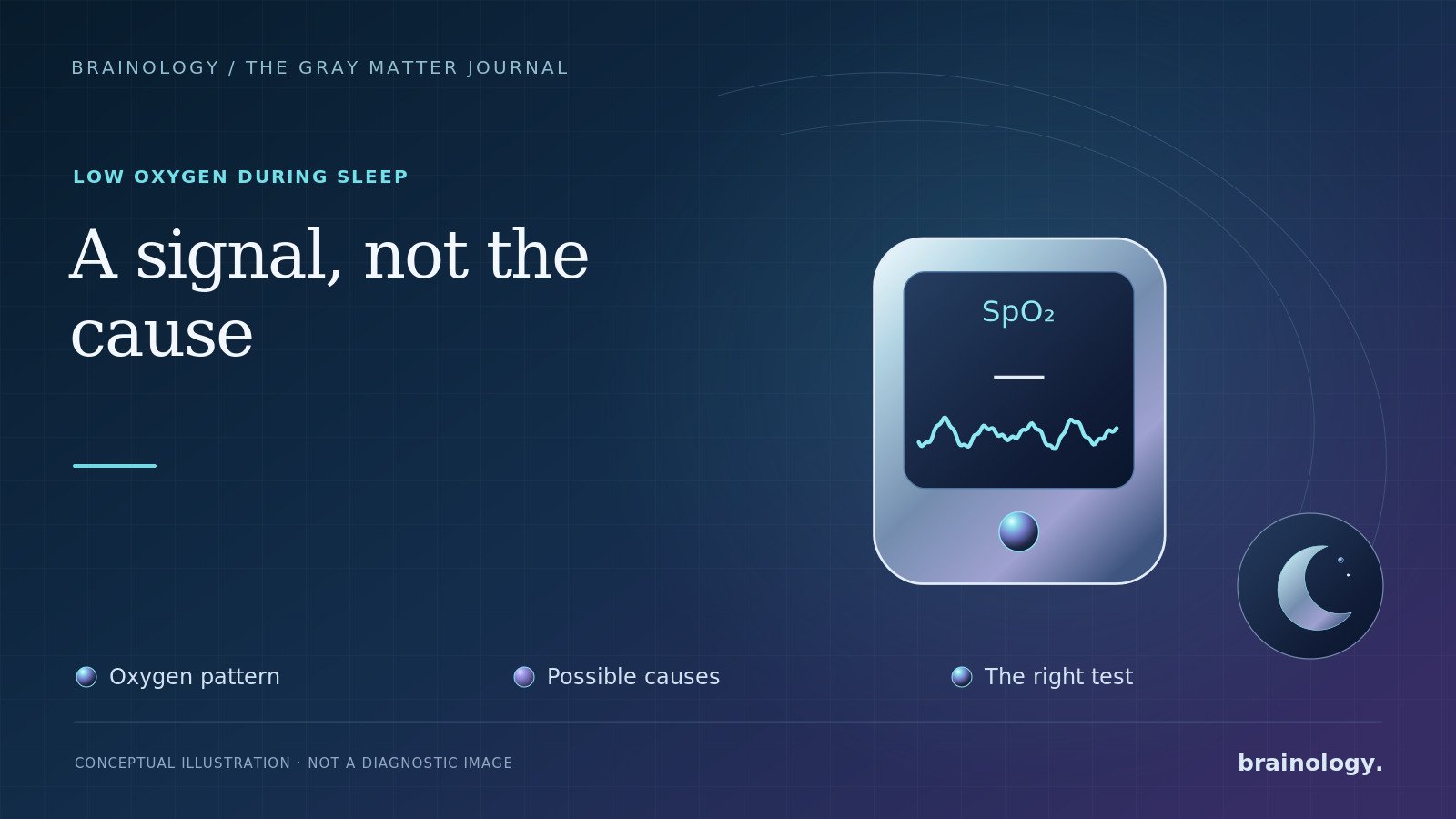
A smartwatch, ring, fingertip monitor, or sleep study may report that oxygen levels dropped during the night. Obstructive sleep apnea is an important possibility, but it is not the only explanation.
Oxygen can fall because the upper airway repeatedly closes, breathing becomes too shallow, the lungs do not exchange gases effectively, or the heart and circulation are not moving oxygen as expected. Sometimes the apparent drop is simply a poor signal.
The number matters, but the pattern, duration, symptoms, medical history, and quality of the recording matter too. Overnight oximetry can identify a problem worth investigating. By itself, it usually cannot make the diagnosis.
What Overnight Oximetry Measures
A pulse oximeter estimates peripheral oxygen saturation, reported as SpO2. During an overnight recording, the report may include:
- Average oxygen saturation
- Lowest recorded saturation, sometimes called the nadir
- Oxygen desaturation index, or the number of qualifying drops per hour
- T90, meaning the percentage or duration of recording time spent below 90%
These measurements describe oxygenation. They do not directly measure airflow, chest and abdominal effort, sleep stages, awakenings, carbon dioxide, or whether the patient was actually asleep.
A brief low value can reflect motion, a loose sensor, cold hands, poor circulation, or another signal problem. The FDA also notes that skin pigmentation, skin thickness, tobacco use, and fingernail polish can affect pulse-oximeter accuracy. Consumer wellness devices are not interchangeable with medical diagnostic equipment.
How Obstructive Sleep Apnea Lowers Oxygen
In obstructive sleep apnea, the airway narrows or closes even though the body continues trying to breathe. Oxygen may fall, then recover when the airway reopens. Repeated events can create a cyclical or sawtooth pattern.
However, not every obstructive event produces a large oxygen drop. Shorter events and respiratory-effort related arousals may repeatedly fragment sleep while causing little desaturation. This is one reason a normal or mildly abnormal oximetry result cannot reliably exclude clinically important sleep-disordered breathing.
Conversely, repeated oxygen drops can occur with central sleep apnea or other breathing disorders. The shape of the oximetry tracing may offer clues, but it cannot determine the mechanism on its own.
Other Causes of Low Oxygen During Sleep
Sleep-related hypoventilation
Hypoventilation means that breathing is not sufficient to clear carbon dioxide. Oxygen may fall while carbon dioxide rises. Possible contributors include obesity hypoventilation syndrome, neuromuscular weakness, chest-wall disorders, chronic lung disease, and medications that suppress breathing, including opioids.
An oximeter cannot measure carbon dioxide. A patient can therefore have a concerning ventilation problem even when the oxygen pattern does not look like classic obstructive apnea. Evaluation may include serum bicarbonate, blood-gas testing, pulmonary assessment, and polysomnography with carbon-dioxide monitoring.
Lung and cardiovascular disease
Chronic obstructive pulmonary disease, interstitial lung disease, pulmonary vascular disease, and some forms of heart failure can lower baseline oxygen or worsen gas exchange during sleep. A patient may also have both a cardiopulmonary condition and sleep apnea. Treating one does not necessarily correct the other.
Altitude
Oxygen pressure decreases with elevation. People who normally live near sea level may desaturate during sleep after traveling to a higher altitude, especially if they have underlying lung disease or sleep-disordered breathing.
Temporary illness or measurement error
Respiratory infections, fluid overload, or an acute worsening of a chronic condition may change overnight oxygenation. Poor sensor contact and motion can create false drops. A single consumer-device alert should be checked in clinical context rather than ignored or treated automatically.
Why a Home Sleep Apnea Test May Not Be Enough
A home sleep apnea test can be appropriate for an uncomplicated adult with a high likelihood of moderate to severe obstructive sleep apnea. It generally measures airflow, breathing effort, heart rate, and oxygen, but it usually does not measure sleep stages or carbon dioxide.
The American Academy of Sleep Medicine recommends attended polysomnography rather than home testing when there is significant cardiorespiratory disease, possible respiratory-muscle weakness, awake hypoventilation or suspected sleep-related hypoventilation, chronic opioid use, a history of stroke, or severe insomnia.
An attended study can record brain waves, sleep stages, airflow, effort, limb activity, heart rhythm, and oxygen. Carbon-dioxide monitoring can be added when hypoventilation is a concern. These signals help determine whether a low saturation resulted from obstruction, reduced respiratory drive, shallow breathing, underlying disease, or artifact.
Oxygen Is a Treatment, Not a Diagnostic Shortcut
Supplemental oxygen may be medically necessary for selected patients, but raising the saturation number does not always treat the process that caused it.
In obstructive sleep apnea, oxygen does not physically open the upper airway. In the HeartBEAT randomized trial, CPAP reduced blood pressure in participants with obstructive sleep apnea and cardiovascular disease or risk factors, while nocturnal oxygen did not produce the same effect. That finding does not mean oxygen is never appropriate. It shows that correcting desaturation and treating airway obstruction are not equivalent interventions.
Oxygen also requires caution when hypoventilation is possible. In randomized crossover studies, supplemental oxygen increased carbon dioxide in some people with obesity-related hypoventilation. Treatment may need positive airway pressure or noninvasive ventilation to support breathing, with oxygen added only when clinically indicated.
Patients should not start borrowed oxygen, change flow rates, or use an online concentrator without medical guidance.
Questions to Ask About an Abnormal Oxygen Report
Useful questions include:
- Was this a medical-grade recording or a consumer estimate?
- Was the signal reliable throughout the night?
- Were the drops brief and repetitive, or was oxygen continuously low?
- Were airflow, breathing effort, sleep stages, and carbon dioxide measured?
- Could lung disease, heart disease, medications, altitude, or neuromuscular weakness contribute?
- Is a full polysomnogram, pulmonary testing, or blood-gas evaluation appropriate?
When to Seek Prompt Care
Seek urgent medical attention for low oxygen accompanied by severe shortness of breath, blue or gray lips, chest pain, new confusion, fainting, or difficulty staying awake. Repeated low readings while awake also deserve prompt assessment, particularly when they are new or worsening.
The Bottom Line
Low oxygen during sleep is a finding, not a complete diagnosis. Obstructive sleep apnea is common and important, but hypoventilation, lung disease, cardiovascular disease, altitude, medication effects, and measurement error can produce different versions of the same alarm.
Brainology can help review overnight oxygen data, determine whether home testing is appropriate, and arrange more complete sleep testing when the pattern or medical history suggests a complex breathing disorder.
This draft is for educational purposes and clinical and editorial review. It is not a diagnosis or a substitute for emergency care or individualized medical advice.
References
- Kapur VK, Auckley DH, Chowdhuri S, et al. Clinical Practice Guideline for Diagnostic Testing for Adult Obstructive Sleep Apnea. Journal of Clinical Sleep Medicine. 2017;13(3):479-504. PubMed
- Rosen IM, Kirsch DB, Carden KA, et al. Clinical Use of a Home Sleep Apnea Test: An Updated American Academy of Sleep Medicine Position Statement. Journal of Clinical Sleep Medicine. 2018;14(12):2075-2077. PubMed
- Mokhlesi B, Masa JF, Brozek JL, et al. Evaluation and Management of Obesity Hypoventilation Syndrome: An Official American Thoracic Society Clinical Practice Guideline. American Journal of Respiratory and Critical Care Medicine. 2019;200(3):e6-e24. PubMed
- Gottlieb DJ, Punjabi NM, Mehra R, et al. CPAP versus Oxygen in Obstructive Sleep Apnea. New England Journal of Medicine. 2014;370(24):2276-2285. PubMed
- Hollier CA, Harmer AR, Maxwell LJ, et al. Moderate Concentrations of Supplemental Oxygen Worsen Hypercapnia in Obesity Hypoventilation Syndrome: A Randomised Crossover Study. Thorax. 2014;69(4):346-353. PubMed
- Lacasse Y, Sériès F, Corbeil F, et al. Randomized Trial of Nocturnal Oxygen in Chronic Obstructive Pulmonary Disease. New England Journal of Medicine. 2020;383(12):1129-1138. PubMed
- Hajipour M, Labarca G, Ayas N, Azarbarzin A. Nocturnal Hypoxemia in Respiratory Medicine: Pathophysiology, Measurement, and Association With Outcomes. Seminars in Respiratory and Critical Care Medicine. 2025;46(2):221-232. PubMed
- U.S. Food and Drug Administration. Pulse Oximeters. Accessed September 29, 2026. FDA