Sleep Medicine and Sleep Testing
Central Sleep Apnea Is Not the Same as Obstructive Sleep Apnea
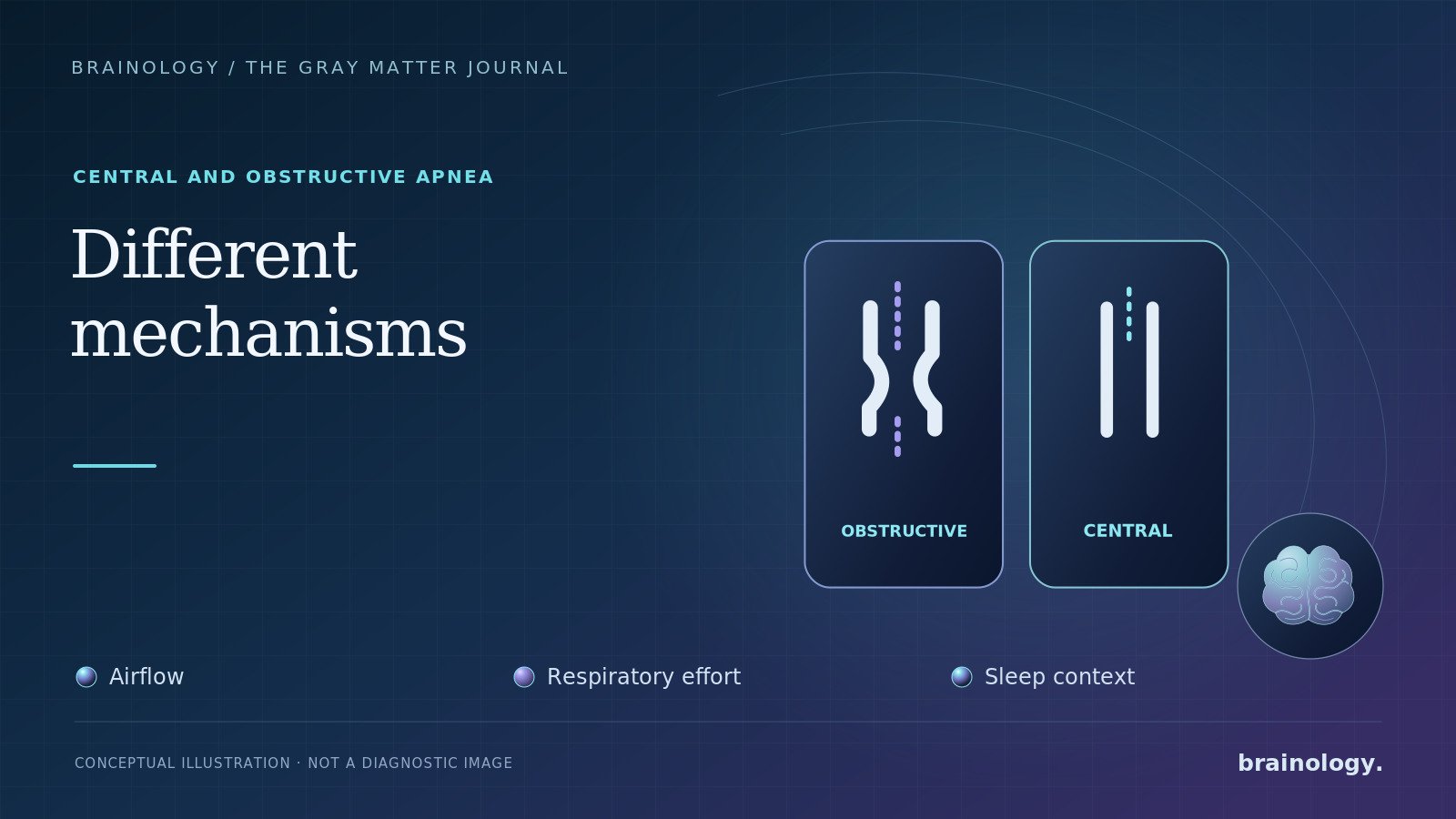
Obstructive sleep apnea involves a blocked airway. In central sleep apnea, breathing effort temporarily falls. The distinction changes which tests and treatments are appropriate.
When a sleep study shows repeated pauses in breathing, the next question is not simply, “How many?” It is also, “What caused them?”
Obstructive sleep apnea and central sleep apnea can both interrupt airflow, disturb sleep, and lower oxygen levels. Yet they arise through different mechanisms. In obstructive sleep apnea, the upper airway narrows or closes while the body continues trying to breathe. In central sleep apnea, the brain’s respiratory control system temporarily reduces or stops the signal that drives breathing, so airflow and breathing effort fall together.
That distinction matters. A treatment that holds the airway open may work well for obstruction but may not fully address unstable breathing control. Central events can also point toward heart failure, medication effects, high-altitude exposure, or another medical condition that deserves attention.
Same Pause, Different Mechanism
During an obstructive apnea, air stops moving even though the chest and abdomen continue to make breathing efforts. Think of it as a closed passage with the breathing muscles still pulling.
During a central apnea, air stops because respiratory effort temporarily disappears. It is sometimes said that the brain “forgets to breathe,” but that phrase is too simple. Breathing is regulated by a feedback system that responds to carbon dioxide, oxygen, sleep stage, medications, altitude, and signals from the heart and lungs. In some people, that system becomes unstable during sleep and cycles between too much and too little breathing.
These categories can overlap. A person may have both obstructive and central events, and the pattern can change during the night or after treatment begins.
What a Sleep Study Looks For
A laboratory polysomnogram records airflow, oxygen, brain waves, heart rhythm, and movements of the chest and abdomen. Those effort signals help a sleep specialist distinguish an obstructive event from a central one. The report may include an overall apnea-hypopnea index, or AHI, along with separate obstructive and central indices.
The numbers still need context. A few central pauses can occur around sleep onset or after an arousal and do not automatically establish central sleep apnea. Clinicians consider how often events occur, what proportion are central, whether breathing follows a repeating pattern, whether sleep or oxygen is disrupted, and whether the findings fit the patient’s symptoms and medical history.
Symptoms alone usually cannot separate the two conditions. Snoring and gasping lean toward obstruction, but central sleep apnea may also cause witnessed pauses, repeated awakenings, shortness of breath at night, fatigue, or daytime sleepiness. Some people have few obvious symptoms.
Why Central Events Happen
Central sleep apnea is not one single disease. Common clinical settings include:
- Heart failure: Some people with heart failure develop a waxing-and-waning breathing pattern called Cheyne-Stokes breathing. Treating the heart condition is a central part of care.
- Opioids and other respiratory depressants: These drugs can alter respiratory drive and produce central or irregular breathing. Medication changes must be clinician-guided; abruptly stopping an opioid can be unsafe.
- High altitude: Lower oxygen levels can destabilize breathing, especially soon after ascent.
- Neurologic or other medical conditions: Stroke and certain disorders affecting breathing control may contribute, although central apnea should not be assumed to identify a specific neurologic disease.
- Treatment-emergent central sleep apnea: Central events may appear when positive airway pressure successfully opens an obstructed airway. This was once called complex sleep apnea.
- Primary central sleep apnea: Sometimes no clear cause is found after an appropriate evaluation.
Finding central events should prompt a review of heart and neurologic history, medications and substances, altitude exposure, and prior sleep-study or PAP data. The goal is not merely to label the pattern, but to understand why it is present.
Why a Home Sleep Apnea Test May Not Be Enough
Home sleep apnea tests are useful for selected adults with a high likelihood of uncomplicated obstructive sleep apnea. They are not equivalent to a full polysomnogram. Most do not record brain waves, and devices vary in how they measure respiratory effort. They may underestimate event frequency because monitoring time is not the same as measured sleep time.
The American Academy of Sleep Medicine recommends laboratory polysomnography rather than home testing when significant cardiorespiratory disease, chronic opioid use, prior stroke, suspected hypoventilation, neuromuscular weakness, or severe insomnia is present. These are also settings in which central or otherwise complex breathing may need closer characterization.
A home test that is negative or inconclusive should not end the evaluation when symptoms and clinical concern remain.
Treatment Follows the Cause
There is no universal “best machine” for central sleep apnea. The 2025 AASM guideline emphasizes matching treatment to the cause, comorbidities, polysomnographic findings, and the outcomes that matter to the patient. Reducing a number on the report is not enough if sleep, symptoms, and overall health do not improve.
Options may include:
- Treating contributing conditions: Optimizing heart-failure care, reviewing respiratory-depressant medications, or addressing another underlying condition may improve breathing stability.
- Continuous positive airway pressure: CPAP is often tried first. It holds the airway open and can improve central apnea in some patients, particularly when obstructive events coexist.
- Bilevel PAP with a backup rate: This device can deliver a timed breath when spontaneous effort is absent. Bilevel PAP without a backup rate can worsen central apnea in some situations and is not recommended as a general CSA treatment.
- Adaptive servo-ventilation: ASV adjusts pressure support from breath to breath and can control certain central or mixed patterns. Heart-failure status must be considered carefully before it is prescribed.
- Low-flow oxygen or acetazolamide: These may be appropriate for selected causes, including some cases related to heart failure or high altitude. Both require individualized medical oversight.
- Transvenous phrenic nerve stimulation: An implanted system stimulates the phrenic nerve to move the diaphragm during sleep. It is an option for selected adults with moderate to severe central sleep apnea, but it is invasive, costly, and generally considered after less invasive approaches.
The evidence behind several treatments is limited. Many recommendations in the 2025 guideline are conditional because studies are small, populations differ, and long-term outcomes remain uncertain.
ASV and Heart Failure Require Special Care
ASV deserves a separate conversation. In the 2015 SERVE-HF trial, one ASV approach increased all-cause and cardiovascular mortality in people with symptomatic heart failure, a left ventricular ejection fraction of 45% or less, and predominantly central sleep apnea. A later trial using a different ASV strategy did not find increased mortality, but it also did not reduce cardiovascular events or death.
These findings should not be collapsed into “ASV is always dangerous” or “ASV is proven safe for everyone.” The current AASM guideline conditionally supports ASV for several forms of central sleep apnea, while advising shared decision-making, experienced-center care, and close monitoring when heart failure with reduced ejection fraction is present.
Treatment-Emergent Central Apnea Is Not Necessarily Treatment Failure
If central events appear during a CPAP titration or in the first weeks of therapy, it can be unsettling. In some patients, the pattern settles as breathing control adapts and obstructive events remain controlled. In others, central events persist and another approach is needed.
The practical response is follow-up, not panic. A clinician may review mask leak, pressure settings, medications, heart function, symptoms, and detailed device or sleep-study data. Changing modes too quickly can add complexity, while ignoring persistent central events can leave sleep-disordered breathing inadequately treated.
Questions to Ask About Your Report
If central events appear on a sleep study, useful questions include:
- Were most events obstructive, central, or mixed?
- Did the central events occur only while falling asleep, or throughout the night?
- Was there a Cheyne-Stokes pattern or meaningful oxygen disruption?
- Could heart disease, medication, altitude, or another condition be contributing?
- Is an in-lab study, titration, or cardiac evaluation needed?
- How will treatment success be judged beyond the AHI?
At Brainology, sleep-study interpretation is connected to the whole clinical picture. If your report shows central events, mixed apnea, or a pattern that does not fit your symptoms, a sleep-medicine evaluation can help clarify what the numbers mean and what should happen next.
This draft is for general education and does not replace individualized medical advice. New or severe shortness of breath, chest pain, confusion, fainting, or bluish discoloration requires urgent medical evaluation.
References
- Badr MS, Khayat RN, Allam JS, et al. Treatment of central sleep apnea in adults: an American Academy of Sleep Medicine clinical practice guideline. J Clin Sleep Med. 2025;21(12):2181-2191. doi:10.5664/jcsm.11858.
- Kapur VK, Auckley DH, Chowdhuri S, et al. Clinical practice guideline for diagnostic testing for adult obstructive sleep apnea. J Clin Sleep Med. 2017;13(3):479-504. doi:10.5664/jcsm.6506.
- Cowie MR, Woehrle H, Wegscheider K, et al. Adaptive servo-ventilation for central sleep apnea in systolic heart failure. N Engl J Med. 2015;373(12):1095-1105. doi:10.1056/NEJMoa1506459.
- Bradley TD, Logan AG, Lorenzi Filho G, et al. Adaptive servo-ventilation for sleep-disordered breathing in patients with heart failure with reduced ejection fraction: the ADVENT-HF trial. Lancet Respir Med. 2024;12(2):153-166. doi:10.1016/S2213-2600(23)00374-0.
- Costanzo MR, Javaheri S, Ponikowski P, et al. Transvenous phrenic nerve stimulation for treatment of central sleep apnea: five-year safety and efficacy outcomes. Nat Sci Sleep. 2021;13:515-526. doi:10.2147/NSS.S300713.
- U.S. Food and Drug Administration. remedē System, P160039. Approved October 6, 2017; page updated October 23, 2017.